Advancing LLMs with RAG
Introduction to RAG and LLMs
Large Language Models (LLMs) have made tremendous progress in recent years, with models like GPT-4o and Claude 3.5 Sonnet demonstrating unprecedented capabilities in natural language understanding and generation. However, these models are not without their limitations. One of the significant challenges facing LLMs is their tendency to hallucinate or provide inaccurate information, which can be detrimental in applications where factual accuracy is crucial.
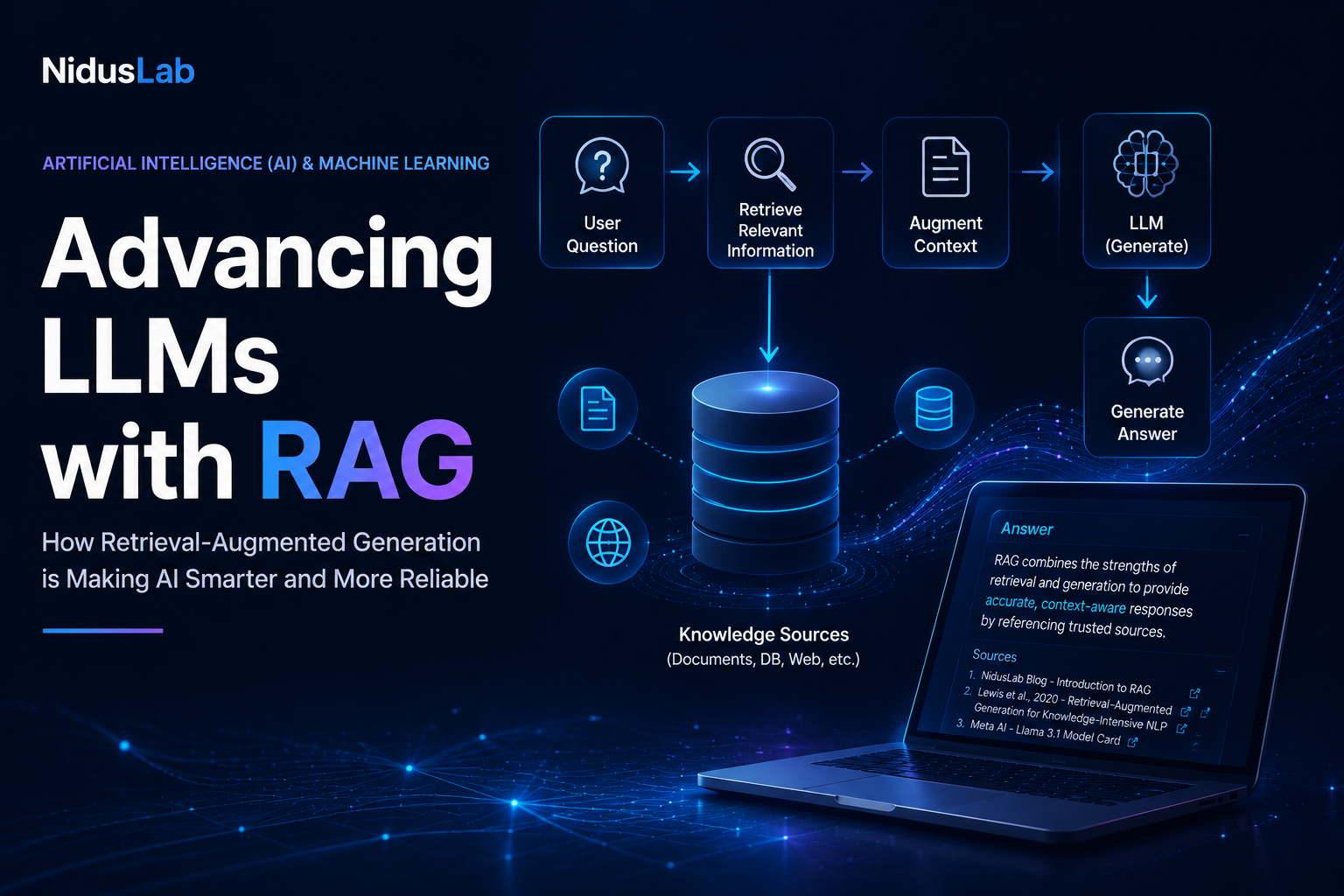
RAG, or Retrieval-Augmented Generation, is a technique designed to address these limitations by augmenting the generation process with external knowledge sources. This approach enables LLMs to retrieve relevant information from databases or the internet and incorporate it into their responses, significantly enhancing their accuracy and informativeness.
How RAG Works
RAG operates by integrating a retrieval mechanism into the generation process of an LLM. This mechanism allows the model to search for relevant information in external sources and use this information to inform its responses. The process can be broken down into several key steps: information retrieval, information integration, and response generation.
The retrieval step involves searching for relevant information in external sources based on the input prompt. This information is then integrated into the generation process, where the model uses it to inform its response. The final response is generated based on both the input prompt and the retrieved information, resulting in a more accurate and informative output.
Real-World Use Case: Enhancing Customer Support with RAG-Enabled LLMs
A practical example of the application of RAG-enabled LLMs can be seen in customer support chatbots. Traditional chatbots often struggle to provide accurate and helpful responses due to their limited knowledge base and inability to understand context. By integrating RAG into an LLM, a chatbot can retrieve relevant information from a database or the internet and use this information to provide more accurate and helpful responses to customer inquiries.
For instance, if a customer asks about the return policy of a specific product, a RAG-enabled LLM can retrieve the relevant information from the company's database and provide a detailed and accurate response. This not only improves customer satisfaction but also reduces the need for human intervention, making the support process more efficient.
What to Watch in the Next 6-12 Months
As RAG technology continues to evolve, we can expect to see significant advancements in the capabilities of LLMs. One area to watch is the integration of RAG with other AI technologies, such as computer vision and speech recognition, to create more comprehensive and interactive AI systems.
Another area of interest is the development of more sophisticated retrieval mechanisms that can efficiently search and retrieve information from large and complex databases. This will be crucial for applications where speed and accuracy are paramount, such as in real-time customer support or emergency response systems.
For developers and tech decision-makers looking to leverage RAG-enabled LLMs in their applications, it is essential to stay updated on the latest advancements and best practices in the field. Partnering with a knowledgeable and experienced AI solutions provider like NidusLab can provide valuable insights and support in navigating the complex landscape of AI and LLMs.